
Once Lost Re-Acquiring them will be Difficult (Understatement?).
A lifetime in the defence and security world is enough to convince one that it is the unattended things that cause the problems.
All too frequently we play fast and loose with the unsexy things in defence because politicians see no votes in them, ignore threats and make decisions to take risks. They then hide behind mealy-mouthed phrases such as “It is what the scientists/senior officers/advisers/the mob/press/party/polls* (delete if not appropriate) told us. We were simply following the advice (whilst trying to stay in power)” and concepts such as “collective responsibly” (not me guv) when reality strikes. One only has to look at the desperate efforts of people and institutions; politicians, officials and ministries in particular, at the Covid Inquiry trying to wriggle off the hook to see the validity of this contention.
One can put together a list longer than this article to confirm the contention, but the issues are legion. Sacrificing ships’ designed damage control measures, which nearly did for the Falklands Task Force, ignoring the rise of Japanese Militarism in the 1920s and 30s, paying insufficient heed to the rise in unconventional threats utilizing simple mechanisms, electronics and deployed by those with unfamiliar political or religious doctrine, egged on by direct opponents as part of hybrid warfare and the problems this all causes developed/democratic nations, not paying sufficient attention to electronic warfare, now fashionably called Cyber Warfare, as if it’s something new, are just a few examples of threats ignored on a macro scale to add to CBRN.
Some countries have sacrificed their CBRN capability in recent decades, as the UK and many other countries, understandably, did to deal with the CIED threat from unexpected foes. However not to rebuilt it afterwards is inexcusable. Lost skills are always difficult and time consuming to regain but its ten years since the withdrawal. Work that has come Lutra’ way in that decade has shown that most of those other countries are rebuilding their capability at pace. They recognize the issues and threats CBRN poses. Lutra’s work has shown that it’s a threat other see as being pervasive, persistent and penetrating. It gets into every aspect of defence. It is strange the UK does not seem to have woken up to the threat or at best is trying to hide under the covers because it has more experience of the bogey man’s presence than those other countries.
In peacetime UK has suffered a number of CBRN Incidents which seemingly have had little impact on government perceptions or thinking but which illustrate the ease of delivery, the comprehensive nature, spread and ubiquity of the threats. The lessons of two world wars also seem to seem to be being ignored.
However modern threats and incidents should not be ignored. When the Chernobyl nuclear power plant exploded the resulting radioactive cloud passed over the UK twice. The rain at the time has caused some areas to still be contaminated today. In 1978 Georgi Markov a Bulgarian Dissident was assassinated using Ricin, a biological weapon. In 2018 Novichok was used to try to kill the Skripals, father and daughter, and killed two innocent individuals (the inquiry is really only just happening so the bed clothes must have been both thick and copious).
Add the assassination of Litvinenko using a radiation weapon and repeated attempts by non-states parties to acquire CBRN capability, castor beans and Ricin are particular favourites, and no one can claim the signals are not there. Recent history shows there are plenty of international actors of all stripes quite prepared to use CBRN.
Pandemics and epidemics, and there have been enough of them of late, show you don’t need a deliberate release for the genie to get out of the bottle either. Not a pandemic but in Novichok’s case literally and its was expensive. In all of these incidents the costs have been horrendous and dwarf cybercrime.
Some of the work Lutra has undertaken for four countries across four different domains: land, sea, air and terrorist has shown that the CBRN threat is pervasive, persistent and penetrating and the defence has to match it to be effective. It also shows that whilst the basics are the same the practicalities of each domain mean they are each specialist subjects. One size does not fit all. It all has to be fully developed and encompassing and despite treaties and legislation given man’s ingenuity and ambition to harm other people there are no short cuts or get out of jail cards available.
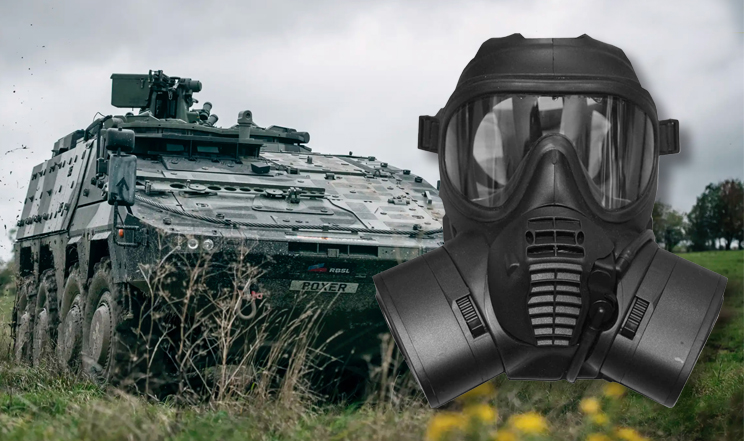
In addition, convenient conceptual fudges have disappeared. As examples: many warships do not have citadels because “the ocean is a big place, and we will simply sail away”. Most wars, and naval operations, are now combined littoral operations and sailing away is not an option. Similarly, the claims that: there is no need for counter CBRN systems in vehicles, or, we can reduce the level of protection afforded by respirators in land operations are at best spurious and at worst murderous. Reality is you cannot afford to run away or have your force reduced in numbers or, critically, when it is small as the UK’s are, effect by the threat or the use of a CBRN attack launched by just a few people. The ground war in Ukraine would have been different and had different outcomes has the Ukrainians run away when the Russians crossed the border. The effect of a full CBRN defensive posture in deterring CBRN’s use are legion. Equally the absence of effective defence facilitating and encouraging CBRN use is just as well documented. Unprotected people and facilities are simply casualty statistics waiting to happen.
A frequent analogy for CBRN defence is a chain. One weak link and you don’t have a strong enough chain that stretches far enough. Too many links have been taken away or weakened and not enough has been done to get new links or a new chain. There are some interesting excuses put forward for this. Some say war gaming, “operational analysis” or “operational research” show that there is a reduced need for all pervasive or protecting counter CBRN defence. Similar, convenient, fig leaves have been disastrous in the past. It is worth remembering that the Argentinians opted to invade the Falkland Islands on the basis that they perceived UK was weak willed and had a reduced military capability illustrated by the decisions to get rid of aircraft carriers based on operational reasons and the Ice Patrol Ship HMS Endurance for financial reasons. Both decisions based on the results of mathematically modelled computer aided war games, “operational analysis” and “operational research”.
The fundamental flaw in these quasi-scientific studies was that the wrong assumptions were fed into the system, in the aircraft carrier decision deliberately by the politicians, from the outset. This is rather like computers and “garbage in garbage out”. If the assumptions are wrong, then the output is wrong. The bible had it right with houses of straw built on sand. If you are a politician and you are not convinced about this then just check how many opinion polls have been proven wrong come real polls. Mathematical models are merely paper made electronic and these days they are even more fragile than before because they have the veneer of truth sprayed on by computers.
So what are the solutions and options. There is always controversy about what needs to be done but some fundamentals are:
• Decide to provide as full a protective CBRN shield as possible.
• Do it as fast as possible recognizing that an initial capability will cost money, probably a lot, but the cost of political, strategic or tactical defeat will be greater and longer lasting and cost many unnecessary deaths and injuries.
• It is probable that this initial procurement will have to be done through some form of rapid procurement or UORs avoiding the usual Treasury delays.
• Once an initial capability is in place set about upgrading the basic defence coverage and posture. More money but having bought time with an initial capability spend that time wisely doing the upgrade thoroughly.
• Talk to industry, especially SMEs who have lots of innovative ideas to help. rather than big behemoths motivated by large shareholder returns.
• Recognise it is not just money required to rebuild capability. Blood, sweat and tears are required too.
• Inculcate the CBRN threat into all aspects of defence and security planning and activity, including public perception. Don’t be worried if the public wake up to the threat unless you have done nothing about it. Be open and honest. The public are robust, they will understand but they won’t forgive platitudinous capability proven to be the straw house built on sand.
• The strategic deterrent is one strong link in the chain. It needs to be surrounded by, many, other links.
• Understand defence is a higher priority than other budget priorities. Don’t shy away from it. Other countries recognise that is it’s better to spend less government money on issues such as health, which can be financed by other means, and spend the savings on defence.

Recent Comments